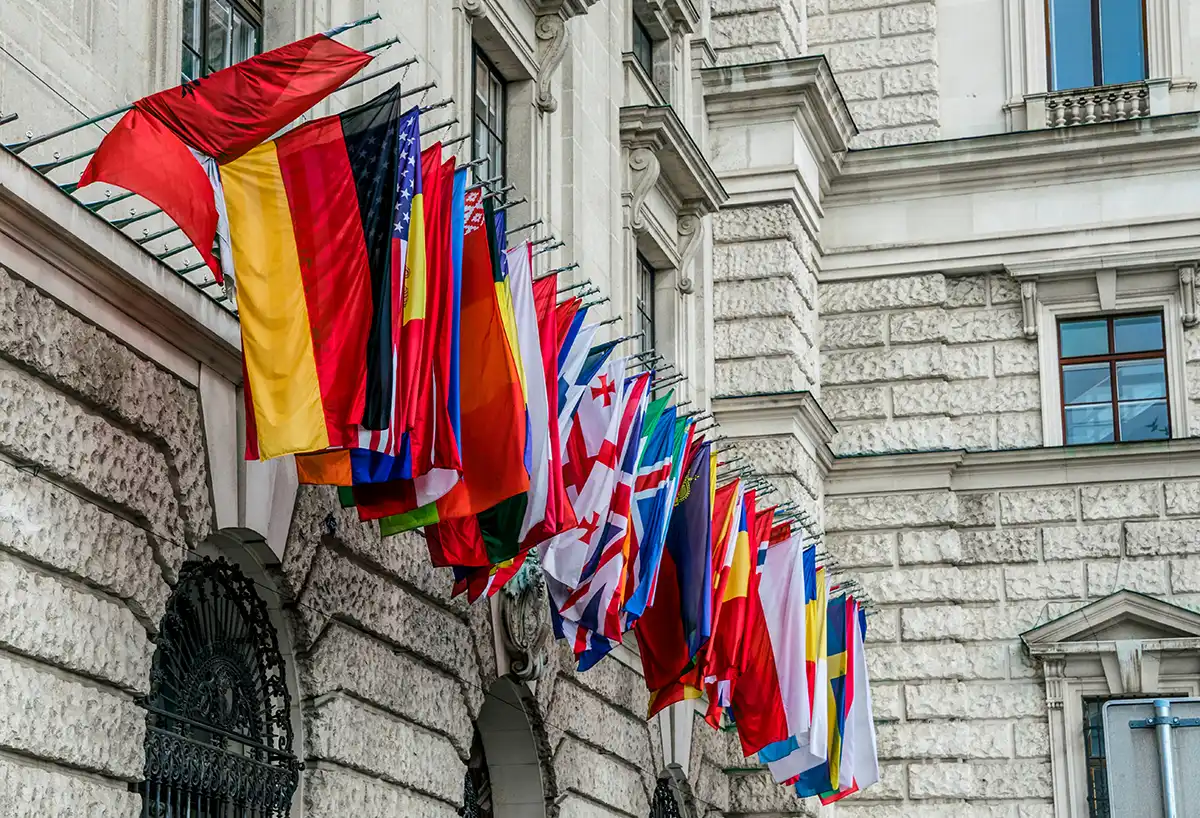
Ireland's diplomatic service has a particular shape. Roughly 100 embassies, consulates and missions to international organisations worldwide — small by G7 standards, but unusually European-weighted and unusually punching-above-its-weight in multilateral fora. The Department of Foreign Affairs runs a network calibrated around EU membership, the Anglo-Irish file, the diaspora (40 million Irish-Americans, large Irish communities in the UK, Canada, Australia, and continental Europe), and a Common Travel Area, single-market and post-Brexit reality that is unlike any other diplomatic profile.
Joining the Irish diplomatic service as a Third Secretary — the recruitment grade — means accepting a working life of three- to four-year postings, decided largely by the Department, in a network that gives a small country disproportionate influence inside European and multilateral institutions.
Most public attention on this career fixates on the salary. That's understandable — Irish civil service pay scales are public, and the word "ambassador" carries enough prestige that people expect the paycheck to match. The reality is more layered: what does an Irish diplomat actually earn, and which postings genuinely shape an Irish diplomatic career?
What an Irish diplomat actually earns
Third Secretary — the entry grade into the Irish diplomatic service — sits on a civil service pay scale that puts new entrants at roughly EUR 40,000 to EUR 50,000 a year. Solid for an Irish public-service entry job; well below what an equivalent qualification would attract in the Dublin tech sector, in the IFSC financial-services hub, or at one of the Big Four. It is not the figure most readers associate with the word "ambassador."
Career progression runs from Third Secretary to First Secretary, then to Counsellor, and finally to Ambassador or Head of Mission. Salaries grow through the public-service scales — First Secretary ranges into the high five figures, Counsellor moves into the low six figures, and an Ambassador or Director-level role typically sits at the upper end of the Irish civil service pay structure, scaling into the higher hundreds of thousands at the most senior heads-of-mission level. On top of base, the Irish DFA operates an overseas-allowances framework that, on average, adds roughly EUR 66,000 per official posted abroad — covering cost of living, dependent provisions, housing and schooling — and substantially more on the most expensive or difficult posts.
But the most interesting part of an Irish diplomatic compensation never appears on a payslip. The real "pay" is structural: a working life across several countries (often heavily European), the access that comes from representing Ireland inside EU rooms where Ireland's voice carries weight disproportionate to its size, the long-tail value of having served at posts that quietly shape the country's foreign-policy identity, and the institutional pride of operating one of the more effective small-state foreign services in the world. That form of compensation explains, more than any pay grade, which postings inside the DFA are quietly sought after.
- EU institutional weight of the host country — Ireland's foreign-policy influence runs heavily through European partners
- Visibility from Iveagh House and the Taoiseach's office — work that's read in Dublin accelerates a career
- Quality of life on post: housing, schools, climate, medical access and family fit
- Diaspora intensity — posts with large Irish communities (Boston, London, Sydney, Vancouver) carry disproportionate consular and political workload
- Multilateral relevance — posts inside major UN systems (Geneva, New York, Vienna, Rome) feature heavily in the career logic of a small-state foreign service

Which DFA postings get fought over rarely comes down to base pay alone. Mandate, representation, daily life and the European institutional weight of the host country carry far more.
LIGHTFIELD STUDIOS / Adobe Stock
Germany is Ireland's largest continental European trading partner, an indispensable EU interlocutor, and the post where the post-Brexit recalibration of Irish foreign policy has been clearest.
The Irish Embassy in Berlin runs what is arguably the most operationally important Irish bilateral file inside the EU. Germany is Ireland's largest continental European trading partner, a critical interlocutor on EU budget and policy questions, and the bilateral where post-Brexit Irish foreign policy has had to recalibrate most directly. The Embassy is supported by Irish consulates in Munich, Hamburg, Stuttgart and Cologne — a regional consular footprint that reflects the size and dispersal of the German market.
What makes Berlin demanding for an Irish diplomat is the multi-layered character of the file. EU coordination on every major Council and Brussels-level question; deep economic and trade work with German industry and the Mittelstand; Ukraine and European security cooperation since 2022; cultural and education ties through the Goethe-Institut, German Department of Education partnerships, and a growing Irish-German bilateral on technology and life sciences. The German-language component carries real weight in DFA promotion logic.
For an Irish diplomatic career, a Berlin tour is the kind of posting that compounds. Mid-career officers grow into the post; ambassadors built on Berlin tend to carry credibility on the rest of the EU file afterwards. The destination — Berlin as a city — also offers quality-of-life conditions that Irish diplomatic families find easy to absorb.
Vienna hosts the UN, the OSCE, the IAEA and a hub of multilateral organisations — and the Irish Embassy operates inside that ecosystem with disproportionate influence.
The Irish Embassy in Vienna is one of those posts whose public profile sits below its actual strategic value to Irish foreign policy. Austria hosts the headquarters of the United Nations Office at Vienna, the OSCE, the International Atomic Energy Agency, UNIDO, the Comprehensive Nuclear-Test-Ban Treaty Organisation, and dozens of other multilateral bodies. For a small-state foreign service like Ireland's, presence inside the Vienna ecosystem is operationally weighty in a way few comparable bilateral posts can match.
What makes a Vienna tour distinctive for an Irish diplomat is the dual track. The bilateral relationship with Austria — substantive, friendly, and built on a common European neutrality tradition — runs alongside the much larger multilateral file. Disarmament and non-proliferation, OSCE security policy, UN sanctions oversight, and the wider Vienna-based intergovernmental ecosystem all sit on this post's desk.
For mid-career Irish officers building a multilateral profile — and for the broader career logic of a foreign service that punches above its weight in international institutions — Vienna is a post that quietly defines a generation. The destination itself, with its cultural depth and family-friendly conditions, makes the tour a sought-after one.
A small bilateral post that quietly carries a substantial workload because of the Geneva multilateral file just down the road.
The Irish Embassy in Bern is on the surface a small bilateral post in a small Western European country. The reality is more layered. Switzerland is one of Ireland's most significant European trade and financial partners outside the EU — a flow that runs through Zurich's financial industry, the Swiss pharmaceutical sector (Roche, Novartis), and the substantial Irish-Swiss business community. The bilateral relationship matters more than the political headlines suggest.
What makes Bern a quietly career-relevant post for Irish diplomats is the spillover into Geneva. The Geneva multilateral ecosystem — WTO, WHO, ILO, UN Human Rights Council, UNHCR, and dozens of others — operates a short distance from Bern, and Irish multilateral work in Geneva intersects directly with the Embassy's bilateral file. For an officer building a Geneva-relevant profile, a Bern tour is often a meaningful preparation or complement to it.
The quality of life on post is exceptional. A small federal capital with excellent infrastructure, world-class schools, accessible nature, and short reach to the rest of Europe. For Irish diplomatic families, Bern is one of the more comfortable European postings the network offers — and for officers building a career that includes the Geneva-Vienna-Brussels multilateral triangle, it has a specific career value.
Embassy, consulate and honorary consulate are not the same career experience
Anyone considering the Irish diplomatic service should understand the difference between embassy, consulate and honorary consulate postings. The distinction is not cosmetic. It changes the nature of the work, the level of responsibility, and the visibility within the DFA.
An embassy posting concentrates political representation, government-to-government interlocution, and coordination across all sections — political, economic, public affairs, consular, and cultural. A consulate posting puts an officer closer to consular practice and citizen-services workload, often in a city with a substantial Irish community or business presence. An honorary consulate is something else entirely — typically a part-time appointment held by a private citizen of the host country, with limited services and no DFA career path.
For anyone moving from general interest to concrete career planning, the page on the diplomatic career is a natural next step — including the entry process via the Public Appointments Service Third Secretary competition.
Department of Foreign Affairs — Ireland.ie
The official Irish DFA site. Bilateral relationships, the network of Irish embassies and consulates worldwide, consular services, and Ireland's foreign-policy priorities including European Union, multilateral and global engagement.
Roles in the Diplomatic Service — DFA
Official DFA page on diplomatic-service careers. Third Secretary recruitment, the progression to First Secretary, Counsellor and Ambassador, and what each role looks like in practice.
Publicjobs.ie — Third Secretary competition
The Public Appointments Service portal where DFA Third Secretary competitions are advertised. Application requirements, selection process, and the formal entry route into the Irish diplomatic service.
Department of Public Expenditure — Civil Service Pay Scales
Authoritative reference on the Irish civil service pay scales that govern diplomatic-service salaries. The pay scale for Third Secretary, First Secretary, Counsellor and Ambassador grades is determined here.
“The real compensation in an Irish diplomatic career doesn't appear on any civil service pay scale. It shows up in the places you've lived, the relationships you've built, and the question of which postings DFA officers actually compete for inside the service when the salary stops being the criterion.”
If the criterion is the continental European bilateral that most directly shapes Ireland's EU posture, Berlin is the clearest case in this selection. If multilateral influence — disproportionate for a small state — is what matters most, Vienna's UN ecosystem makes it hard to beat. And if substantive bilateral work paired with Geneva spillover and exceptional quality of life is the priority, Bern's quiet career value is worth more than the post's public profile suggests.
These three postings illustrate the structural truth of an Irish diplomatic career: it doesn't run on the world's largest capitals. It runs on European depth, multilateral leverage, and the kind of small-state diplomacy that, done well, delivers influence well above what the country's size would predict. The full Irish network is much larger — Washington and London anchor different files, Brussels carries the Permanent Representation, Beijing and New Delhi reflect Ireland's growing Asian engagement — but these European posts capture what makes the service distinctive.
Read this way, the question that started this article — what does an Irish ambassador earn — turns out to be the wrong frame. The right question is which postings an Irish diplomat would actually fight for inside the DFA if pay grade weren't the criterion. The real compensation in this career is not the monthly base; it's the sum of the places lived, the relationships built, and the rooms where, for a few years at a time, an Irish diplomat was the voice of Ireland.